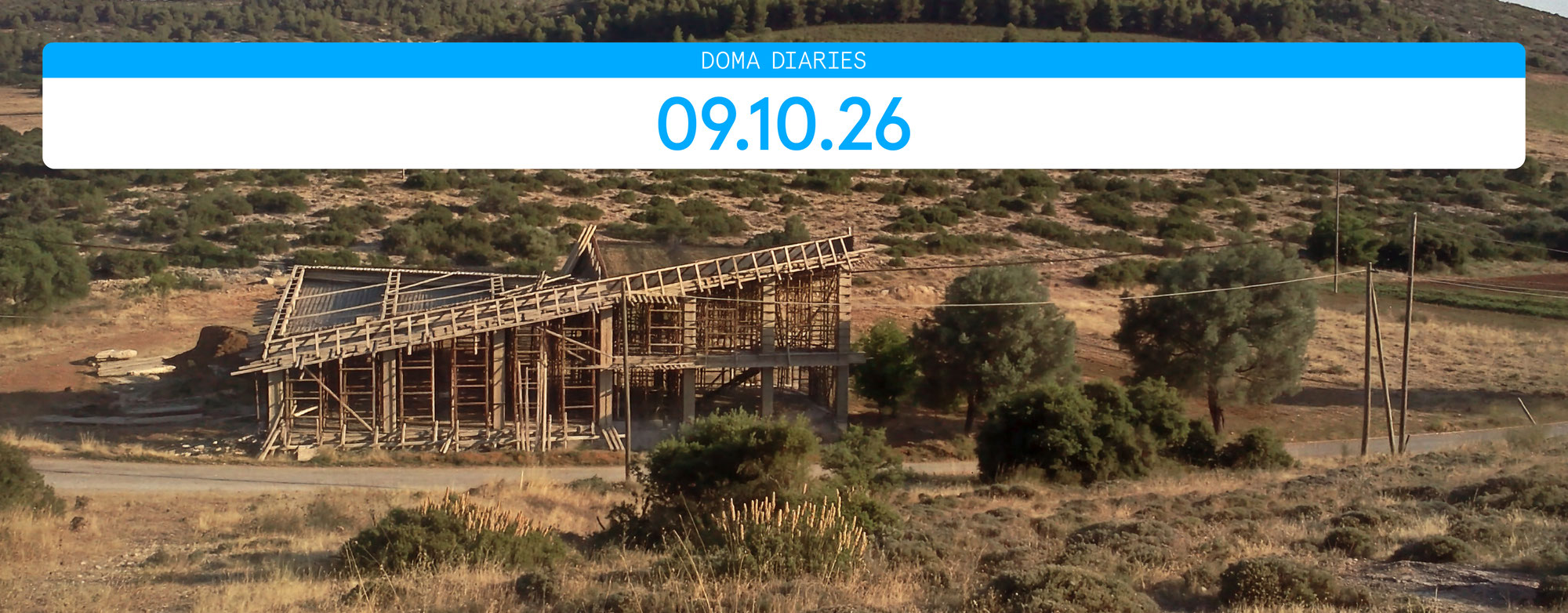
DOMa Diaries 08
Venue
Opening hours
Hashtag
Overview
The eighth edition of DOMa Diaries returned to the Benaki Museum, bringing together seven Greek architects and architectural practices to explore the processes, challenges and unexpected conditions that shape architectural work. Through a series of unbuilt and ongoing projects, the event highlighted how constraints, uncertainty and changing circumstances can become catalysts for inventive architectural solutions.
The programme opened with Urban Soul Project, presenting The Brickhouse, a study of materiality and façade design for KE.BE’s offices in Thessaloniki. Vasileios Dovros followed with CRACK – Printing House, reflecting on the impact of time, economic instability and prolonged construction processes. Fiore Architects presented the D. Daskalopoulos Arts Building at Athens College, exploring the relationship between architectural intention, construction and landscape integration. Fatura Collaborative discussed projects spanning public schools in Thessaly, a therapeutic garden at the Agia Sofia Children’s Hospital and research into the agricultural landscapes of Macedonia, examining architecture’s potential as a tool for healing and social transformation. Nysa Architects presented the transformation of an existing residence in Filothei, while Daskalaki Papadopoulos Architects explored the balance between unity and individuality in a two-family house in Agia Paraskevi. The programme concluded with ksestudio, presenting the redesign of an apartment in the iconic Athens building associated with the television series 'Oi Aparadektoi'.
Across these diverse projects, architecture emerged as an evolving process rather than a fixed outcome—shaped by material experimentation, existing structures, social and environmental challenges, shifting needs and the passage of time. The presentations emphasized the creative potential of uncertainty and the value of remaining open to adaptation, reinterpretation and the unexpected.
The day concluded with a discussion led by Thanasis Manis on behalf of DOMa, extending the individual presentations into a broader reflection on architectural practice. At its core was the recognition that architecture does not offer a single answer, but exists through a plurality of approaches, ideas and possibilities. Architecture, in this sense, is always plural—an open-ended practice in which even the unfinished can hold meaning and potential.